


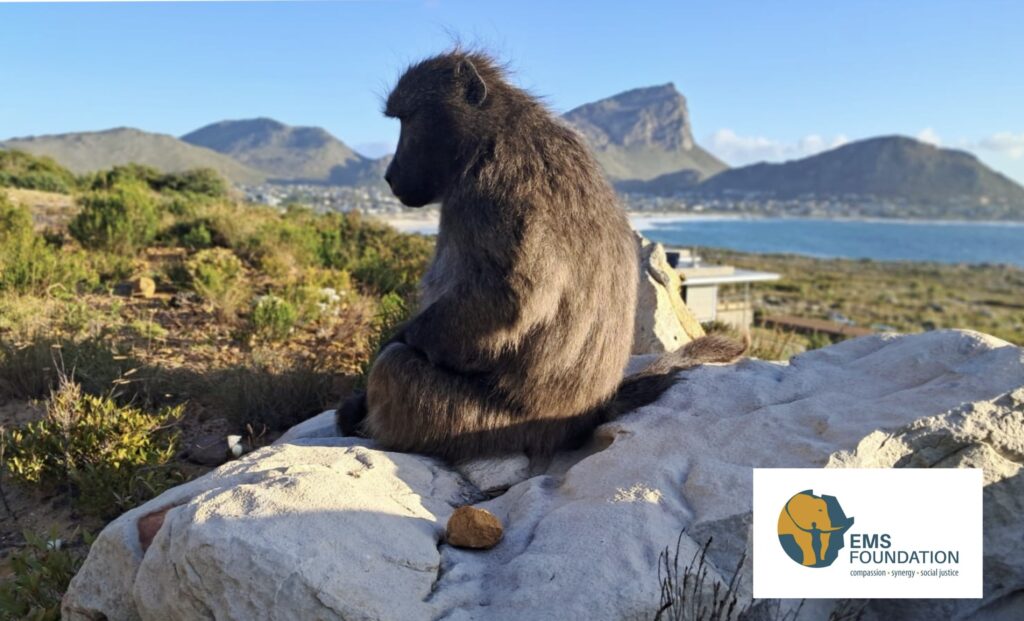
Civil society groups demand an end to killing and a reset of the Overstrand’s relationship with its Chacma baboons. On a mild Monday evening, 3 November 2025, more than 80 residents of the Overstrand gathered at the Marine Hotel. They came not for whales or wine, but for baboons.
The public meeting, open to all, convened by the EMS Foundation, drew conservationists, scientists, residents’ groups, animal protection organisations and concerned locals. Over two hours, no meaningful dissenting voices emerged. In a town often riven by politics, an unusual consensus surfaced: the Chacma baboons of the Overstrand are not the problem. We are.
For years, the Overstrand Municipality’s approach has been packaged as “baboon management” – a neutral-sounding phrase for a system that has included aggressive herding, collaring and, in some cases, killing.
At the Marine Hotel, that framing was turned on its head. Six speakers in environmental law, conservation, environmental learning and wildlife policy set out a shared starting point:
Hermanus “belongs to all who live in it” – human and non-human.
Baboons are sentient beings with intrinsic value, not inherently “problem animals”.
The real driver of conflict is human behaviour and how authorities choose to respond.
Speakers included environmental attorney Cormac Cullinan (Cullinan & Associates; Wild Law Institute), Dr Pat Miller (Whale Coast Conservation), environmental scientist Sheraine van Wyk, Liezl Smith and Francois van Zyl of the Kogelberg Villages Environmental Trustees (KVET), and investigative environmental journalist Dr Adam Cruise.
Their argument was simple: conflict escalates not because baboons are “naughty”, but because humans treat them as intruders in landscapes where humans are in fact the late arrivals. Pringle Bay, also in the Overstrand, was cited as a warning: a hard-line, lethal model has fractured community relationships and harmed the local ecosystem. Hermanus, many warned, is on the same trajectory.
Beyond ethics, the declaration that emerged from the meeting points to a legal problem for the municipality.
South Africa’s Animal Protection Act (Act 71 of 1962) prohibits cruelty and obliges humane treatment of animals. The National Environmental Management: Biodiversity Act (NEMBA, Act 10 of 2004) – in particular Section 9A – requires that biodiversity management plans promote animal well-being and commit to humane practices.
Read together, these laws create a clear duty: a baboon “management” plan that normalises suffering, cruelty or unnecessary killing is not just morally troubling – it may be unlawful.
Participants also voiced anger at the South African Police Service in the area, citing repeated failures to investigate or prosecute deliberate injuring or killing of baboons. That institutional silence, they argued, effectively green-lights cruelty. If no one is ever charged, the message is clear: baboons are expendable.
A recurring theme of the evening was that coexistence will not be achieved with new gadgets or more aggressive rangers, but through changes in human lifestyle.
Residents and experts called for:
A deeper understanding of baboon culture and social structure, including their long-standing presence around human settlements in the Overstrand.
Serious changes to how we manage attractants – food waste, fruit trees, unsecured bins, open doors and windows.
An ethic of respect, or hlonipha, that treats baboons as part of the local community rather than as pests to be suppressed.
As several speakers put it, unless humans transform how we dispose of waste, design settlements and enforce by-laws, “management” will remain an endless, expensive and often violent game of whack-a-mole.
Much of the criticism focused on the Overstrand Municipality’s Adapted Baboon Management Plan, which residents say entrenches a failed paradigm: treating baboons as units to be controlled instead of sentient beings with moral and legal standing.
Mindful of mounting evidence that lethal and aggressive tactics fracture communities and damage ecosystems, participants resolved to:
Call for the immediate halt of the Adapted Baboon Management Plan.
Replace it with a humane, non-lethal strategy based on coexistence, proper waste management, thoughtful urban design and community education.
Insist that any new plan be developed through a transparent, inclusive public participation process.
The declaration reminds the municipality of its own promises. In a budget speech on 29 May 2025, Overstrand Mayor Danie Klaas committed to reviewing the baboon management programme by January 2026, with full public consultation. Residents now intend to hold him to that pledge.
Nowhere is the absurdity of current practice clearer than in how rubbish is handled.
Baboon “raids” on houses and restaurants are often the visible tip of an iceberg of overflowing bins, open skip sites and poorly managed waste transfer stations. Residents at the meeting called on the municipality to start with something simple: implement its own waste by-laws in baboon areas.
That means repairing and upgrading waste sites and bins so they are robust and “baboon proof”, enforcing rules on waste storage and collection in baboon-prone neighbourhoods, and adopting adaptive, proactive waste management instead of reactive, crisis-driven enforcement.
Before reaching for dart guns, collars or kill permits, they argued, the municipality should reach for its by-law book and a decent set of bin clasps.
The declaration also looks beyond daily conflict to long-term planning. It calls for designated wildlife corridors to be built into all future developments; for Overstrand-specific research on baboon social dynamics, foraging and the impacts of urban growth; and for lessons from non-lethal, coexistence-based international models to be applied locally.
Residents further called for the removal of non-functional tracking collars from baboons in the Overstrand, reiterating their offer to assist.
At its core, though, the Overstrand declaration is about belonging. When residents say “the Overstrand belongs to all who live in it”, they challenge a familiar South African pattern: nature as resource to be exploited or nuisance to be fenced off.
The alternative – still fragile but gathering support – is “compassionate conservation”: centring animal well-being, human dignity and ecological integrity at the same time. Our humanity, the declaration suggests, is diminished when we treat sentient neighbours – even messy, clever, inconvenient ones – as disposable.
Whether the Overstrand Municipality takes this challenge seriously remains to be seen. The mayor has set his deadline. Civil society has now set its own.
The baboons are not going anywhere. The question is whether the Overstrand can finally learn to live with them – and, in the process, with itself.
©EMS Foundation. All Rights Reserved.
